The Risk Is Not Becoming Loudoun, It’s Getting a Worse Deal
Loudoun built an enormous data-center tax base after accepting enormous cumulative burdens. Frederick risks accepting many of the same categories of risk for smaller, later and less certain public returns.


A Loudoun County official recently offered a useful warning about Northern Virginia’s data-center economy: the tax revenue is enormous, but so are the cumulative costs. That comparison matters in Frederick County. It also needs one important adjustment.
Frederick is not yet getting Loudoun-sized revenue. It may nevertheless be accepting many of the same categories of long-term environmental, infrastructure and governance risk.
That is the more troubling possibility. The danger is not simply that Frederick could become another Loudoun. It is that Frederick could get a worse version of the bargain.
Loudoun At Least Collected Loudoun-Sized Revenue
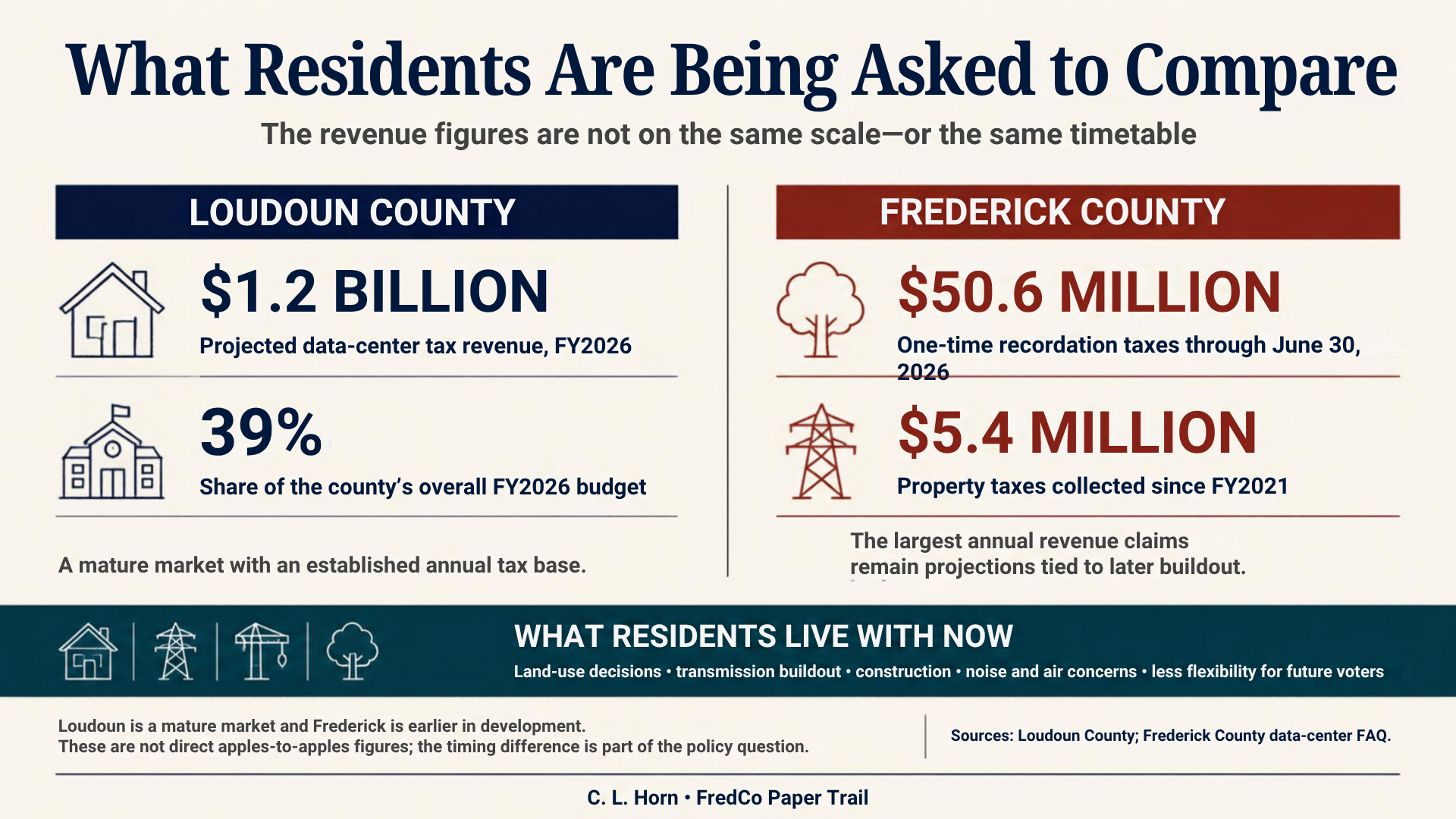
Loudoun County says data centers are expected to generate about $1.2 billion in local tax revenue in fiscal 2026, equal to 39 percent of the county’s overall budget. For fiscal 2027, the county projects about $1.3 billion, or 40 percent of the budget.
That level of dependence creates its own risks. A government receiving two out of every five dollars from one industry has strong incentives to keep that industry growing. Loudoun has also had to confront the land, transmission, water, noise and air-quality consequences of becoming the country’s best-known data-center market.
But there is no ambiguity about the scale of Loudoun’s fiscal return. The money is already supporting the county budget.
Frederick County’s current numbers tell a different story.
Frederick’s Current Return Is Much Smaller
According to Frederick County’s own data-center FAQ, the industry had produced $50.6 million in one-time recordation taxes through June 30, 2026 and $5.4 million in property taxes since fiscal 2021.
Those are real revenues. They are not nothing. But they are not Loudoun’s recurring billion-dollar tax base.
This is not a perfect apples-to-apples comparison. Loudoun is a mature market, while Frederick is still near the beginning of a proposed buildout. That difference, however, is central to the policy question—not a reason to wave it away.
Frederick is being asked to make durable land-use and infrastructure decisions now. Much of the claimed recurring fiscal return lies years in the future.
The Biggest Frederick Number Is Still A Projection
The most prominent long-term estimate comes from an HR&A analysis commissioned by the Quantum Frederick developer. It projected roughly $215 million a year in Frederick County fiscal revenue at full buildout in 2036, including about $208 million in real-property taxes.
That projection should be part of the debate. It should not be mistaken for money already collected or guaranteed.
The analysis used a larger development scenario—about 17.4 million square feet—than the later proposed cap of 15 million square feet. It was presented in 2025 dollars, excluded county costs and incentives from its fiscal calculation, and depended on assumptions about construction, valuation and the pace of full buildout.
In other words, Loudoun’s number largely describes an existing revenue stream. Frederick’s largest number describes a modeled future.
The $110 Million DRRA Was Not A Gift
The proposed development-rights-and-responsibilities agreement, or DRRA, was often discussed as a $110 million community-benefits package. County Executive Jessica Fitzwater rejected it on September 14.
The rejection was justified. But the public discussion should go further than whether $110 million sounded large.
The right question is: $110 million in exchange for what?
The draft agreement would have supported as much as 15 million square feet of development across roughly 1,327 acres, with an eight-year term and a possible five-year extension. It included provisions addressing the effect of later county restrictions, remedies including injunctions or damages, and possible reimbursement or suspension consequences tied to a moratorium. It also contemplated county assistance with land-preservation status changes and, under defined circumstances, an eminent-domain process for developer-funded public infrastructure.
Meanwhile, the advertised benefits were not simply a $110 million check. The package combined direct payments, infrastructure, mitigation, land, conditional obligations and reallocations.
Even taken at face value, $110 million works out to about $7.33 for each square foot of permitted development, about $83,000 per acre, or roughly $8.5 million a year if the arrangement lasted the full 13 years.
Those figures do not prove the agreement was worth exactly that amount. They expose the missing denominator. The public was repeatedly shown the value flowing from the developer to the county, without an equivalent valuation of the rights, certainty and legal leverage flowing from the county to the developer.
The entire one-time package was only about half of the developer-sponsored projection for a single year of county revenue at full buildout.
The DRRA was therefore not merely flawed in its conditions. It also appears low-value relative to the scale and duration of what the developer wanted.
Frederick Does Have Protections
It would be inaccurate to say Frederick County has done nothing to control data-center impacts.
The county has adopted a 55-decibel nighttime noise limit at residential and institutional properties, required Tier 4 backup generators, restricted generator testing, created a Critical Digital Infrastructure overlay, installed four air-quality monitors and paused new data-center applications until July 1, 2027. Site-specific environmental plans are also required.
Those safeguards matter. Loudoun itself ended by-right data-center development in March 2025 and now requires a special exception, showing how late-arriving regulation can be harder once an industry is deeply established.
Frederick has the opportunity to act earlier.
But having a list of protections is not the same as having a complete system for measuring and limiting cumulative harm.
The Whole-System Accounting Is Still Missing
Maryland’s environmental records treat the Frederick projects through multiple permits and project-specific reviews. That is normal for permitting. It can also obscure what residents experience as one regional buildout: combined generator emissions, transmission corridors, water demand, construction traffic, noise, land conversion and pressure on neighboring communities.
Four monitors do not by themselves answer the decisive questions:
- What baseline conditions existed before construction?
- What thresholds trigger investigation or enforcement?
- How quickly must results be reported publicly?
- Who pays for independent testing after complaints?
- What happens if multiple facilities are individually compliant but collectively harmful?
- How are environmental burdens compared with the public revenue actually received?
Frederick County’s own Data Center Workgroup recommended baseline measurements, defined reporting intervals, complaint-based testing, penalties, a noise-abatement fund and county staff monitoring. Those recommendations reveal the infrastructure of accountability still needed.
A promise to monitor is not the same as a rule governing what happens when monitoring detects a problem.
The Timing Makes Frederick’s Bargain Riskier
The costs and benefits arrive on different schedules.
Land-use approvals, transmission development, construction disruption and changes to rural landscapes can begin before the tax base reaches anything close to maturity. Some harms may be difficult or impossible to reverse. The largest revenue claims, by contrast, depend on facilities being built, valued and operating years from now.
That timing gap gives the public less protection than a headline revenue figure suggests.
If the buildout slows, technology changes, valuations fall or promised facilities never reach full scale, Frederick may still retain much of the infrastructure and land-use burden. The public needs a bargain that performs under less optimistic scenarios—not only the developer’s full-buildout case.
The Strongest Counterargument
Supporters can fairly argue that Frederick is not Loudoun. The county is acting earlier, using an industrial brownfield, requiring an overlay and environmental plans, and imposing safeguards that Loudoun did not have at the beginning of its boom. The county also says it has not offered local tax incentives to attract the industry.
All of that matters.
It is also why this is the moment for stronger accounting. Frederick still has leverage. It can require transparent comparisons before the tax base becomes indispensable and before private agreements make future policy changes more expensive.
The lesson from Loudoun is not “reject every data center.” It is “do not let projected revenue become the reason government stops measuring the full price.”
Put Both Sides Of The Bargain On One Page
Before Frederick County approves another major agreement or resumes accepting applications, residents should be able to see one public ledger that includes:
- recurring county revenue actually collected;
- one-time taxes and payments, identified separately;
- projected revenue with assumptions and uncertainty ranges;
- county infrastructure and service costs;
- developer obligations, including conditions and refund provisions;
- the market value of development rights and legal certainty granted;
- cumulative air, water, noise, grid and land-use impacts;
- enforceable thresholds, remedies and responsible agencies; and
- results under partial-buildout and lower-valuation scenarios.
That ledger would not settle every dispute. It would at least make the trade visible.
Loudoun accepted enormous cumulative burdens and built an enormous revenue stream. Frederick County should not accept the first half of that equation on the promise that the second half may arrive later.
The risk is not just becoming Loudoun.
It is getting less protection, less dependable revenue and less future control for the same kinds of permanent change.