Rowan Mailer Audit, Part 15: What Do Rowan’s Sustainability Numbers Actually Measure?
Rowan’s supporting documents qualify its headline sustainability figures. This audit separates modeled savings, construction claims, targets and independently verified results.

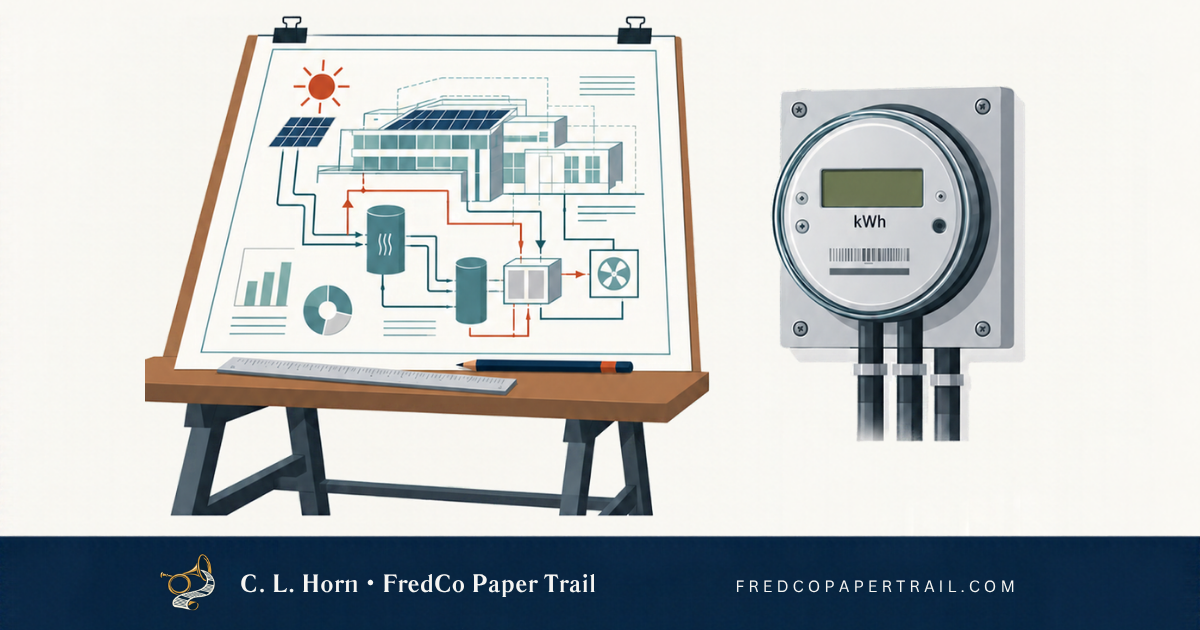
Rowan’s sustainability claims arrive as precise numbers. The qualifications take more work to find.
Its Bauxite I case study supplies some of them. That deserves credit. It also gives Frederick County residents a way to test whether the company’s public claims say what its supporting evidence actually measures.
Energy Efficiency And Energy Cost Are Different Measures
Rowan’s website advertises a 17 percent increase in energy efficiency at Bauxite I. Its case study reports estimated energy-cost savings of 16.68 percent, modeled against the 2021 International Energy Conservation Code baseline.
The case study provides a comparison standard. It does not establish a measured reduction in the campus’s electricity use or explain how the website’s broader efficiency label maps to that cost estimate.

Pages 10–11 of Rowan’s Frederick County mailer. Source material reproduced for reporting, criticism and fact-checking; the article compares these claims with the company’s supporting case study.
The Carbon Claim Covers Part Of Construction
Rowan’s case study describes a projected 23 percent embodied-carbon reduction for foundations, structures and building enclosures. It says material quantities and product declarations were tracked.
Embodied carbon concerns emissions associated with building materials. It is distinct from emissions associated with electricity used after a facility opens.
Planting, Preservation And Targets Need Separate Labels
The case study divides Rowan’s tree figure into about 10 acres preserved through a County easement and 18 acres planted. It also reports recycling 75 percent of nonhazardous construction waste and pursuing BREEAM Excellent certification.
Those statements describe different activities and stages. Rowan’s current web pages add another distinction: Sustainable Impact gives an 85 percent waste-diversion target, while Sustainability & ESG lists a 75 percent target for nonhazardous construction waste. The pages reviewed do not reconcile their scopes or periods.
BREEAM’s guidance directs readers to certificates and certified-assessment listings to verify a rating.
The Supporting Documents Deserve Scrutiny And Credit
Rowan’s case study answers questions the mailer leaves open. It supplies enough detail to narrow the criticism. An audit should acknowledge that.
The reviewed material does not supply the calculation files, independent assurance findings or final project certificate needed to verify the results separately.
Rowan has published some methodology. What remains missing from the reviewed record is a clear account of which results were independently verified, by whom and against what evidence.
Sources
- Rowan’s Frederick County mailer, pages 10–11.
- Rowan’s Bauxite I Sustainability Case Study.
- Rowan: Sustainable Impact.
- Rowan: Sustainability & ESG.
- BREEAM: How BREEAM Works.
Previous: Rowan Mailer Audit, Part 14.