The Public Learned Last: Frederick County’s Shameful Data-Center Transparency Record
County officials and private representatives shaped Frederick County’s data-center policy while the public Sugarloaf planning process stalled. Residents obtained the central drafting record only after the law passed and litigation forced disclosure.

A note from C. L. Horn: Pardon my frustration in this article. This timeline began as an attempt to reconstruct what had been happening in Frederick County all this time. Much of what follows was new information to me—even after years of public controversy over data centers. That is precisely the problem.
We elect representatives because ordinary people cannot spend their lives excavating staff emails, decoding vague public language, litigating for records and comparing years of corrected ethics reports just to understand how a major land-use policy was made. We are entitled to expect our government to tell us, candidly and in time to matter, what it is doing in our name.
Frederick County residents did not simply “miss” the beginning of the data-center story. The beginning was kept from them—behind an Amazon nondisclosure agreement, private drafting with company representatives, a proposed lie by omission about why the Sugarloaf plan had stalled, and closed sessions whose public record violated Maryland’s Open Meetings Act. The consequential work was happening out of public view during the COVID-19 public-health emergency, when ordinary oversight was already painfully difficult. People were not merely “busy” or distracted. They were getting sick, grieving deaths, caring for children and vulnerable relatives, losing work, and trying to hold their families together while public life and government meetings moved online.
In early 2021, while much of public government remained virtual, County staff halted forward progress on an official public planning process for the Sugarloaf area while they evaluated properties for a data-center initiative. Staff and private representatives were simultaneously developing proposed data-center zoning before residents knew which properties were under consideration—or even that “critical digital infrastructure” meant data centers. (released-email reporting; Circuit Court findings)
The label itself obscured the industry it described, and staff knew it: Livable Frederick Director Kimberly Golden Brandt asked internally how long the County could “get away with ‘critical digital infrastructure’” before having to explain what it meant. (Circuit Court findings)
When an unidentified Frederick County Council member asked why the Sugarloaf draft had not been presented, County Council Legislative Director and Chief of Staff Ragen Cherney asked County Chief Administrative Officer Rick Harcum how to respond. On April 13, 2021, Harcum asked Planning and Permitting Director Steve Horn whether it was “safe” to say that staff had “other work priorities” that temporarily delayed the plan. Horn replied, “I think that’s fair and correct.” (released-email reporting)
One week earlier, Horn had documented the specific reason internally: “Forward progress on the Sugarloaf Plan was halted while we sort through the specific properties under consideration for the data centers initiative.” (released-email reporting)
That was not merely a half-truth. It was a lie by omission. The vague “other work priorities” explanation would have concealed the reason Horn had already documented internally. The fact that the data-center initiative was technically County work did not make that proposed answer honest. It made the lie easier to defend.
The County Council later met privately with Amazon representatives (Open Meetings Compliance Board opinion) and enacted the CDI zoning law in March 2022 (adopted Bill 22-05).
Residents did not obtain the central drafting record until a court-ordered release in June 2023, approximately fifteen months after the vote. (Circuit Court findings and fee order)
They reconstructed the story backward: through clues, public-records requests, litigation, corrected ethics reports and documents produced after the policy had already been enacted. (Appellate Court opinion; Circuit Court findings)
The Core Transparency Timeline
The record: The access imbalance becomes clearest when the drafting, public decision and later disclosure are placed on the same clock.
Timeline
- June 14, 2019: The Frederick County Office of Economic Development signed an Amazon nondisclosure agreement. The document was signed for the County office by Helen Propheter. It names Amazon.com, Inc. and unspecified affiliates, but no Amazon representative countersigned it. Propheter became president and CEO of the Frederick County Chamber of Commerce on September 1, 2026. After FredCo Paper Trail requested information about the Chamber search, recusals, conflict review, governance procedures and Board vote, the Chamber declined to provide it. Her public-role profile documents the request and response.
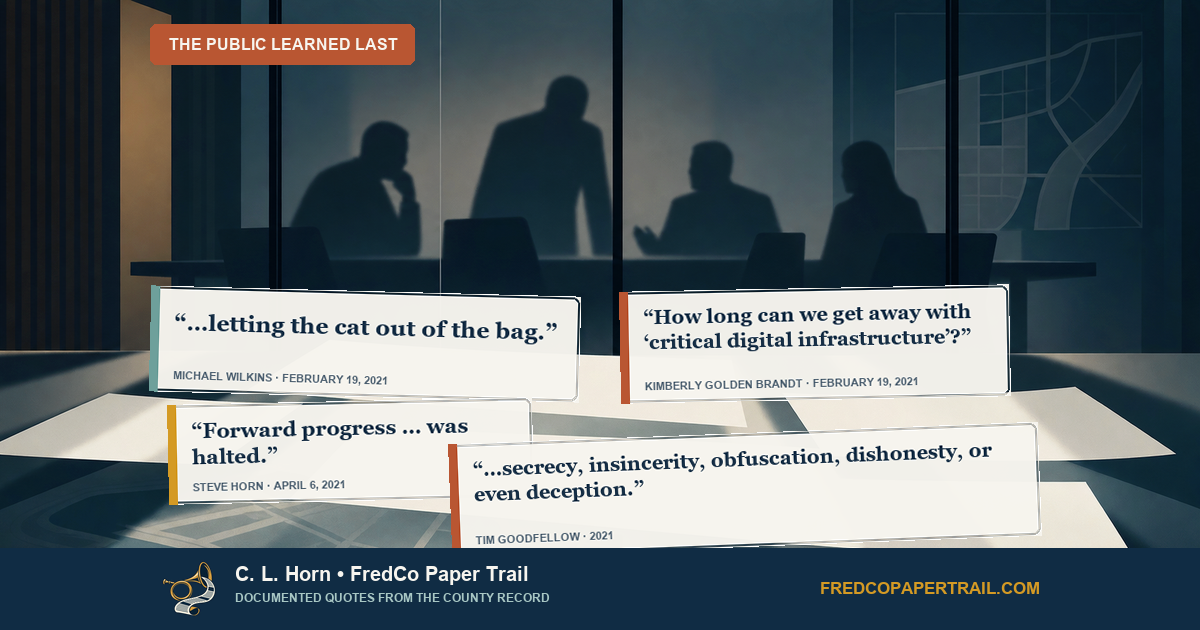
- February 19, 2021: Development Review Director Michael Wilkins warned that answering ordinary floating-zone questions could risk “letting the cat out of the bag.” Livable Frederick Director Kimberly Golden Brandt responded that she had wondered how long the County could “get away with ‘critical digital infrastructure’” before being pressed to explain what it was. (released-email reporting)
- March 11–12, 2021: Wilkins wrote that draft CDI language could go to AWS. Economic Development Director Helen Propheter sent the draft to private land-use attorney Bruce Dean while copying County Executive Jan Gardner, Wilkins and Brandt. (released-email reporting and Circuit Court’s description of the production)
- March 23, 2021: Dean returned an implementation memorandum and proposed zoning language on behalf of Amazon Web Services and Rodgers Consulting. His recommendations included private CDI electrical substations. Dean later reappeared as the developer-side lawyer transmitting drafts of the proposed Quantum/Catellus DRRA in summer 2026. On August 31, he sent County attorneys revised § 8.4(E) language, a clean version 17.2 and a redline against version 16. County Attorney Bryon Black forwarded those files internally at 12:18 p.m. on September 1—53 minutes before the County’s 1:11 p.m. public announcement of the proposed agreement. (released-email reporting and Circuit Court findings and Frederick County MPIA production R002098-090326, pages 31–33)
- Late March or early April 2021: Sugarloaf environmental planner Tim Goodfellow warned Brandt that developing CDI privately rather than through the public Sugarloaf process could subject staff and the department to scrutiny. His email said the work should proceed in a way that “does not subject me, you, and the Planning Department to charges of secrecy, insincerity, obfuscation, dishonesty, or even deception.” The News-Post report dates the email March 29. The Circuit Court’s later description identifies an April 2 email.
- April 6, 2021: In an internal email to County employees—not a public statement—Planning and Permitting Director Steve Horn wrote: “Forward progress on the Sugarloaf Plan was halted while we sort through the specific properties under consideration for the data centers initiative.” (released-email reporting)
- April 12–13, 2021: County Council Legislative Director and Chief of Staff Ragen Cherney asked Chief Administrative Officer Rick Harcum how to answer a councilmember who wanted to know why the Sugarloaf draft had not been presented. Harcum then asked Planning and Permitting Director Steve Horn whether it was “safe” to say that staff had “other work priorities.” Horn replied, “I think that’s fair and correct.” (released-email reporting)
- August 16 and 24, 2021: The County Council met in closed session regarding the confidential business proposal later identified as Amazon’s. Maryland’s Open Meetings Compliance Board found that the Council’s closing statements and records violated state law. released records and later reporting identified the AWS participants.
- March 15, 2022: The Council adopted Bill 22-05 by 7–0. The seven yes votes were cast by Council President M.C. Keegan-Ayer, Vice President Michael Blue, and Council members Jerry Donald, Jessica Fitzwater, Kai Hagen, Phil Dacey and Steve McKay. The CDI law took effect May 14. (County’s 2022 bill record and official 2022 Council membership record)
- June 8–16, 2023: A Circuit Court judge ordered more than 100 withheld records released. The County produced nearly 800 pages, and residents finally received the central drafting history. (News-Post report on the production)
The Story Began With An Agreement The Public Could Not See
The record: On June 14, 2019, Helen Propheter, then executive director of the Frederick County Office of Economic Development, signed a nondisclosure agreement with Amazon Web Services and two AWS affiliates. The proposal later known inside County government as Project Holiday contemplated an approximately $30 billion data-center investment involving multiple locations in southern Frederick County. (News-Post reporting)
The NDA limited disclosure of information about AWS, its services and the proposed project to people with a need to know. County lawyers later interpreted it as applying throughout the executive branch and to information shared with the County Council. (News-Post reporting)
County Council members told the News-Post that they had not individually signed the agreement. (News-Post reporting) The document reviewed by FredCo Paper Trail bears Propheter’s signature for the County. That distinction matters: this was an executive-branch economic-development agreement whose secrecy later affected a much wider set of officials and public decisions.
Helen Propheter became the new CEO of the Frederick Chamber of Commerce earlier this year.
Amazon Helped Shape The Zoning Language Before The Public Knew The Subject
The record: Records released in June 2023 show that Amazon representatives and private development professionals participated in Frederick County’s proposed Critical Digital Infrastructure zoning work during early 2021. The Circuit Court later identified the developer memorandum, draft maps, County responses and internal emails among the significant produced records.
The people writing about secrecy were not peripheral employees. They occupied the offices responsible for development review and long-range planning.
Michael Wilkins was the County’s director of Development Review and Planning, and he later presented Bill 22-05—the legislation creating CDI as a County land use—to the Planning Commission. (County legislative and planning record) In other words, he was part of the chain converting the concept into legislation.
On February 19, 2021, Wilkins emailed Kimberly Golden Brandt about a problem with the proposed CDI floating zone: how to accommodate parks, agricultural processing and other agricultural uses without disclosing what the zone was actually being designed to support. “Its not something we can easily address without letting the cat out of the bag,” he wrote. (released-email reporting)
“...not something we can easily address without letting the cat out of the bag.”
Michael Wilkins, director of Development Review and Planning · February 19, 2021 · Source
Brandt was then the director of the Livable Frederick Planning and Design Office—the County unit responsible for comprehensive and long-range planning, including the Sugarloaf Treasured Landscape Management Plan. She replied the same day that she had wondered how long the County could “get away with ‘critical digital infrastructure’” before being pressed to explain what it meant. (released-email reporting)
“I’ve wondered how long we’re going to be able to get away with ‘critical digital infrastructure’ before we’re pressed on what exactly this is all about.”
Kimberly Golden Brandt, director of Livable Frederick Planning and Design · February 19, 2021 · Source
That exchange was not merely two planners joking about an awkward name. The development-review director and the long-range-planning director were discussing how to write a generally applicable zoning category around a project the public had not been told about. Their immediate problem was that normal planning questions could expose the undisclosed project behind the new terminology. (released-email reporting)
The drafting trail then moved outside County government. On March 11, Wilkins circulated draft CDI language internally and wrote that Helen Propheter, then the County’s economic-development director, would pass it to AWS. On March 12, Propheter sent draft zoning language to private attorney Bruce Dean while copying County Executive Jan Gardner, Wilkins and Brandt. (released-email reporting and Circuit Court’s description of the production)
Dean was not a County lawyer or staff planner. He was a private Frederick land-use and real-estate attorney whose practice includes rezoning, development approvals, public-private agreements and Development Rights and Responsibilities Agreements. (firm biography)
On March 23, he returned an implementation memorandum and suggested zoning language on behalf of Amazon Web Services LLC and Rodgers Consulting. The email went to Brandt, Wilkins and County official Gary Hessong and copied, among others, developer Tom Natelli, consultant Eric Soter, Rodgers president Dusty Rood and attorney Lisa Graditor. (released-email reporting and Circuit Court findings)
One of Dean’s proposals was to allow nongovernmental electrical substations as a principal CDI use. Earlier February and March drafts described in the released record did not contain those substation provisions. The law enacted in 2022 did. (released-email comparison)
Tim Goodfellow was a Livable Frederick environmental planner working directly on the Sugarloaf plan. The County identified him as the public contact for that planning process. (County Sugarloaf announcement) He was therefore not an outside opponent discovering the process after the fact. He was a planner inside the office whose public plan was being displaced.
In a late-March/early-April 2021 email to Brandt, Goodfellow questioned why the CDI changes were being developed privately instead of through the public Sugarloaf planning process. He asked how planners could carry out the administration’s desire for digital-infrastructure areas “in a manner that is open and transparent” without exposing the staff and Planning Department to charges of “secrecy, insincerity, obfuscation, dishonesty, or even deception.” He added that he did not want their reputations and the department’s integrity sacrificed to the initiative. (released-email reporting; Circuit Court findings)
The Frederick News-Post report identified the email as March 29. The Circuit Court’s later description identifies an April 2 email. The underlying production should be checked before assigning a final date.
“...open and transparent, and does not subject me, you, and the Planning Department to charges of secrecy, insincerity, obfuscation, dishonesty, or even deception.”
Tim Goodfellow, Livable Frederick environmental planner · late March or early April 2021 · Source
The internal explanation for the Sugarloaf delay sharpens Goodfellow’s warning. On April 6, Planning and Permitting Director Steve Horn wrote that “forward progress on the Sugarloaf Plan was halted while we sort through the specific properties under consideration for the data centers initiative.” (released-email reporting)
“Forward progress on the Sugarloaf Plan was halted while we sort through the specific properties under consideration for the data centers initiative.”
Steve Horn, director of Planning and Permitting · April 6, 2021 · Source
On April 12, County Council Legislative Director and Chief of Staff Ragen Cherney asked Chief Administrative Officer Rick Harcum how to answer a councilmember asking why the draft Sugarloaf plan had not been presented. The following day, Harcum asked Horn whether it was “safe to just say that your staff have had other work priorities that have temporarily delayed this?” Horn replied, “I think that’s fair and correct.” (released-email reporting)
“Is it safe to just say that your staff have had other work priorities that have temporarily delayed this?”
Rick Harcum, chief administrative officer · April 13, 2021 · Source
“Other work priorities” was a lie by omission. Staff knew the specific reason the Sugarloaf draft had been stopped: they were sorting properties for the undisclosed data-center initiative. Substituting a vague category for that documented reason would have concealed the truth from the councilmember and the public. The fact that the data-center initiative was technically County work did not make the proposed answer honest. It made the lie easier to defend.
The County had publicly launched Sugarloaf as its official process for planning the area’s future. (County announcement) The records reviewed here do not show a contemporaneous public announcement that forward progress had been halted for the data-center initiative.
From outside government, the Sugarloaf process still appeared to be the place where the County was considering the area’s future. Inside government, staff had paused it while data-center zoning and property questions moved through a private channel. (released-email reporting)
The Council’s Closed-Meeting Record Violated State Law
The record: On August 16 and August 24, 2021, the Frederick County Council held closed sessions concerning a confidential business proposal. (Open Meetings Compliance Board opinion) Later released records and reporting established that the sessions concerned Amazon’s data-center proposal and included senior AWS representatives and County staff. (released-record reporting)
Maryland law permitted the Council to close a meeting for specified purposes, including certain business-location negotiations and legal advice. But the Council still had to vote publicly, prepare an adequate written closing statement, explain why private discussion was necessary, identify the topics with meaningful specificity and keep legally sufficient minutes. (Open Meetings Compliance Board opinion)
On November 29, 2021, Maryland’s Open Meetings Compliance Board found that the Council violated General Provisions §§ 3-305(d) and 3-306(c). The Council did not prepare or adopt an adequate closing statement. Its agendas repeated the broad statutory phrases for business location and legal advice without meaningfully describing the subject or explaining the reason for secrecy. Its closed-session minutes and later public summary also lacked required detail. (full Board opinion)
The records were so deficient that the Compliance Board could not determine whether the Council’s actual discussion stayed within the legal exceptions. (full Board opinion)
The Law Changed Before Residents Saw The Drafting Record
The record: Amazon’s Project Holiday proposal collapsed in 2021 after the company and the County failed to agree on the development schedule. (News-Post reporting) But the zoning initiative outlived the project.
On March 15, 2022, the County Council adopted Bill 22-05 by a 7–0 vote. Jerry Donald, Steve McKay, Jessica Fitzwater, M.C. Keegan-Ayer, Michael Blue, Phil Dacey and Kai Hagen all voted yes. The law took effect May 14. (County’s 2022 bill record) It defined CDI facilities and private CDI substations, made them principal permitted uses in the Limited Industrial and General Industrial zones subject to site-plan approval, and established design requirements. (adopted bill)
Residents could attend the formal legislative process and comment on the bill. (County’s legislative record) What they could not see was the earlier drafting record showing that AWS had received draft language, that Dean had returned proposed changes on behalf of Amazon and Rodgers Consulting, that the County had responded to those comments, or that planners had discussed how long CDI could remain unexplained. (released-record reporting and Circuit Court findings)
A Circuit Court judge ordered the County to produce more than 100 previously withheld records on June 8, 2023. (Circuit Court findings and fee order) The County released nearly 800 pages on June 15, and the Frederick News-Post reported the key emails on June 16. (News-Post report)
The sequence is the accountability failure: the Council changed County law in March 2022 (adopted Bill 22-05), the law became effective in May 2022, and residents did not receive the central drafting history until June 2023—approximately fifteen months after the vote. (Circuit Court findings and News-Post report) The opportunity to evaluate who shaped the bill arrived after every councilmember had already enacted it.
Residents Had To Sue To Reconstruct The Process
The record: On October 19, 2021, Sugarloaf Alliance submitted Maryland Public Information Act requests seeking records that could explain abrupt changes to the Sugarloaf Plan and the rumored data-center initiative. The organization sued Frederick County in June 2022 after the requested record production remained incomplete. (Circuit Court’s factual findings)
On June 8, 2023, Frederick County Circuit Court Judge Robert Greenberg ordered the County to release more than 100 previously withheld records. (Circuit Court findings and fee order) The resulting production totaled nearly 800 pages. (News-Post report) The County sought reconsideration. The court denied that request in July. (News-Post report on reconsideration)
The released material revealed Amazon’s involvement in the zoning work, private comments on draft language, the internal debate about maintaining ambiguity and the relationship between the stalled Sugarloaf process and properties under consideration for data centers. (released-record reporting and Circuit Court’s description of significant records)
The Access Imbalance Did Not End With Amazon
The record: Later Public Ethics Reports and lobbying disclosures show repeated direct contacts between elected officials, developers and consultants during active land-use and data-center policy work.
Eric Soter moved from senior County planning leadership into private consulting. In the second half of 2022, County lobbying records listed him as a lobbyist for Natelli Holdings II, Natelli Communities and Monocacy Land Company.
During the same general transition period, he served on County Executive-elect Jessica Fitzwater’s Housing and Quality of Life transition committee. (transition report) He later joined the County Executive-appointed IW2 Advisory Group and participated in a September 2025 Eastalco tour with Tom Natelli, Catellus representative Michael Kuykendall and Council Vice President Kavonté Duckett. (July–December 2025 Public Ethics Report)
Don Pleasants of Pleasants Development also served on the IW2 Advisory Group. He later requested CDI-overlay inclusion and LI/GI rezoning for properties he said could provide storage and parking needed for data-center construction. (County guide to overlay and rezoning requests) A Public Ethics Report records that Council Member Renee Knapp toured properties requested for inclusion or rezoning with him in December 2025.
The same report documents private briefings, project updates, property presentations and tours involving Catellus, Rowan Digital Infrastructure, Windridge, the Geisinger family and other stakeholders.
None of those contacts is automatically improper. Government officials can meet applicants, landowners, consultants, advocates and residents. The accountability question is comparative: who received access before choices were framed, what material was exchanged, when the contact became public and whether residents and competing interests had a meaningful opportunity to influence the same stage.
The Disclosure System Still Requires Its Own Audit
The record: Frederick County publishes Public Ethics Reports under Maryland General Provisions § 5-861 to summarize covered communications involving elected officials and outside interests. (County Public Ethics Report page) Our comparison of original, revised and later reports found useful disclosures—and significant record-quality problems.
The revised July–December 2023 report disclosed four Sugarloaf Alliance meetings between 51 and 176 days after the reported communication dates. A Quantum Loophole meeting concerning a live Maryland Department of the Environment dewatering issue first appeared 37 days after the meeting and appeared again in a revised report with a submission date 73 days after the meeting. (July–December 2023 report)
The original January–June 2025 report misidentified several people and entities. Its later revision corrected “Bill Riedl and Caroline Riedl” to Bill Reid and Caroline Milam, “Sauc Company” to Saul Company, and other substantive wording. A later filing corrected an entry that had attributed transmission of draft CDI legislation to both Jerry Donald and Steve McKay: Donald said McKay sent the material to Tom Natelli and Donald was copied. That correction was submitted 96 days after the underlying communication.
The July–December 2025 report includes apparent variants or errors such as “Catellas,” “Tom Natali,” “Eric Sotor” and “Michael Kykendall.” The County’s Ethics Commission page now links semiannual Public Ethics Reports from 2016 through 2025. That is an improvement. The archive still does not clearly preserve every original report after a revised version replaces it, making it difficult to reconstruct what changed and when.
These problems do not establish that every delay or error violated a statutory deadline. The governing submission requirements and underlying affidavits still need review. They do establish that the public summaries cannot simply be downloaded and treated as a complete, timely and clean account.
The County Opened The Process After The Damage Was Done
The record: Frederick County later created far more visible data-center proceedings. County Executive Fitzwater created a Data Centers Workgroup that held eight public meetings before issuing its report. The Planning Commission and County Council conducted workshops and hearings on later siting and design legislation. (County CDI Overlay record) The County now maintains a data-center information page and a Public Ethics Report dashboard.
Those meetings were public. The workgroup was not independent oversight. It was an appointed stakeholder body whose members brought identifiable institutional and professional interests to the table. The final roster included a sitting County Council member and the executive director of Mobilize Frederick as co-chairs, the CEO of the Maryland Tech Council, a Rodgers Consulting land-development consultant, representatives of IBEW Local 24 and the Frederick County Farm Bureau, environmental advocates, a Sustainability Commission chair, a Brunswick councilmember and software engineer, and a business and technology consultant.
That range of experience could improve the discussion. It did not make the body neutral. The official roster does not identify a dedicated seat for:
- a resident living beside a proposed site
- an independent public-health specialist
- an independent grid or utility-rate expert
- a water-system scientist
- a noise specialist
- a tribal or historic-preservation representative
- someone explicitly representing low-income or already overburdened communities.
Some of those perspectives may have entered through presentations or public comment. They did not hold the same sustained seat, agenda time or role in writing subgroup recommendations as the appointed members.
That distinction is why FredCo Paper Trail previously published A Public Meeting Is Not Public Power. That article examined the County’s later informational open houses, not the 2023–24 workgroup meetings. But the accountability principle is the same: allowing the public to attend, watch, ask questions or comment is valuable. It is not the same as giving residents equal power over the agenda, the draft or the decision.
And the chronology still cannot be laundered into a redemption story. Before those later processes, staff had halted forward progress on the public Sugarloaf plan while private data-center zoning work continued. The Council had taken Amazon’s proposal into closed sessions and violated Maryland’s Open Meetings Act by failing to create the required public record. The Council then enacted Bill 22-05 in March 2022. Residents did not receive the central drafting history until a court forced its release in June 2023.
The County’s strongest defense is that legitimate economic-development negotiations sometimes require confidentiality, that the Amazon proposal did not ultimately proceed (News-Post reporting), and that officials must hear from property owners, advocates and technical experts. That defense explains why some project information might temporarily remain confidential and why a stakeholder workgroup can be useful. It does not turn stakeholders into neutral reviewers, and it does not justify letting private project requirements shape public law while residents were denied the same timely knowledge and access.
The later hearings addressed later rules. They did not reopen the 2021 drafting process, restore the sidelined Sugarloaf work, undo the unlawful closed-meeting record, or give residents a chance to challenge the original policy frame before the 2022 vote. Public participation after the decisive framing choices is not equivalent to public participation in making them. (released-record reporting and Circuit Court findings)
What Full Accountability Would Require
The record: The failures documented here involve different legal and administrative systems. The Open Meetings matter received a formal violation finding. Others involve delayed or corrected ethics disclosures and court-compelled records whose legality must be evaluated separately. A credible repair should therefore be concrete:
- Publish every original, revised and corrected Public Ethics Report with a visible change log.
- Make covered elected-official disclosures searchable as they are filed, with the communication date, submission date, participants, represented interests, subject and attached material.
- Publish closing statements, recorded votes, required summaries and attendance lists for every closed session as soon as the law permits.
- Identify when a confidential economic-development project begins influencing generally applicable legislation, comprehensive planning or zoning maps.
- Publish stakeholder drafts and redlines before hearings whenever confidentiality no longer legally protects them.
- Disclose advisory-group members’ relevant property, client and lobbying interests.
- Preserve historical reports in a complete, indexed public archive.
- Record private tours, technical briefings and applicant presentations with equivalent detail regardless of the official or applicant involved.
- Give residents access before options are narrowed—not merely a microphone after the proposal is written.
The Public Should Not Always Learn Last
Frederick County’s data-center debate is often presented as a disagreement about one industry: tax revenue against land preservation, infrastructure investment against environmental and neighborhood risk.
The paper trail shows another conflict underneath it. Released 2021 records and later Public Ethics Reports document developers and corporate representatives receiving direct access while rules, properties and implementation questions were active. The court-ordered production shows that residents received central parts of the earlier record only after the zoning law had been enacted.
The County’s transparency failures were not all identical. The Open Meetings Compliance Board found actual violations. The Circuit Court compelled records the County had withheld. Ethics-report delays and revisions and archive gaps document a weaker disclosure system, but do not automatically prove additional statutory violations or corrupt intent.
Together, however, they produced the same practical result: the people who would live with the policy often learned its origins only after their leverage had diminished. (Circuit Court findings and released-record reporting)
Sources
Primary And Official Records
- June 14, 2019 AWS nondisclosure agreement
- Sugarloaf Alliance v. Frederick County — Circuit Court findings and attorney-fee order
- Maryland Open Meetings Compliance Board, 15 OMCB Opinions 156 — November 29, 2021
- Frederick County adopted Bill 22-05
- Frederick County 2022 Council Bills index
- Frederick County legislative and planning meeting record used for staff roles and Bill 22-05 presentation
- Frederick County announcement launching the Sugarloaf planning process
- Frederick County Planning Commission letter: continued public participation in Livable Frederick implementation
- Frederick County Sugarloaf planning announcement identifying the staff contact
- Fitzwater transition-team report
- Frederick County lobbyist expenditures, July–December 2022
- Frederick County Public Ethics Report landing page and dashboard
- Frederick County Public Ethics Report, July–December 2023
- Frederick County Public Ethics Report, January–June 2025, revised
- Frederick County Public Ethics Report, July–December 2025
- Frederick County Ethics Commission page, agendas and minutes
- Frederick County IW2 Advisory Group
- County guide to CDI-overlay inclusion and rezoning requests
- Frederick County Data Centers Workgroup record
- Frederick County data-centers information page and FAQ
- Frederick County CDI Overlay proceedings and documents
Court And Reporting Sources
- Released records: Amazon had hand in drafting data center zoning policy — Frederick News-Post via Yahoo
- Judge denies County’s reconsideration request — Frederick News-Post via Yahoo