Carroll Manor Needs More Than a Study -- It Needs an Action Plan
FCPS has ordered a comprehensive study of Carroll Manor Elementary School’s proximity to the Quantum Frederick data-center campus. The RFP must define not only what gets measured, but what findings will trigger action and who will pay.

The Frederick County Board of Education has taken an important first step at Carroll Manor Elementary School: it has admitted that the school system does not yet have enough information.
On September 23, the board directed staff to prepare a request for proposals for a comprehensive study of the school’s proximity to the Quantum Frederick data-center campus. FCPS says the review should cover environmental factors, the school facility and possible mitigation.
That is a reasonable response to a school community asking whether construction and eventual operations could affect children and staff. It is not yet a protection.
The value of this study will depend on questions the board has not publicly answered:
- What will be measured?
- Against what baseline?
- For how long?
- What result will trigger a change at the school?
- Who has authority to require that change?
- And who will pay for it?
Without those terms, “comprehensive” can become a reassuring adjective attached to a report that documents concern without changing a single decision.
One Sensor Cannot Answer Every Question
Frederick County has placed a PurpleAir particulate-matter sensor at Carroll Manor. The county says its network is intended to track local conditions and make information available to the public. In June, county officials reported that Adamstown readings were consistent with readings elsewhere in Frederick County.
That is useful information. It is also limited information.
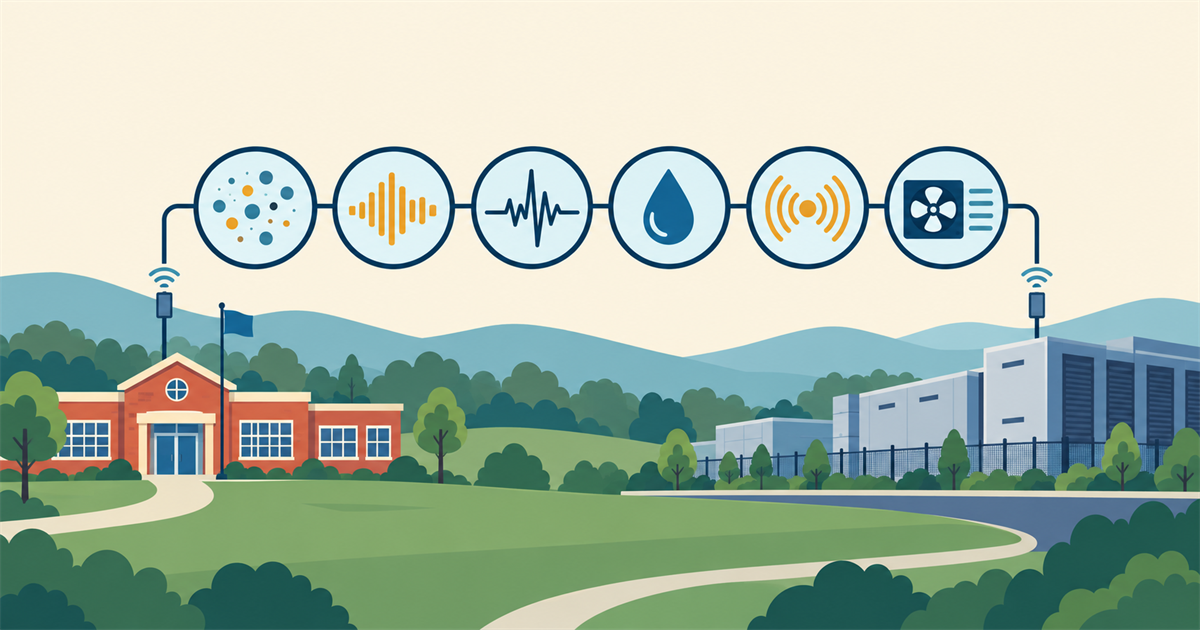
The county network measures fine particulate matter. The U.S. Environmental Protection Agency describes lower-cost air sensors as useful for supplemental and informational monitoring, while warning that humidity, temperature, placement, calibration and other conditions can affect their readings. A sensor outside the school does not by itself measure indoor exposure, identify a pollution source, evaluate the HVAC system or settle questions about noise, vibration, water quality or electromagnetic fields.
That does not make the current monitor worthless. It means the board should be precise about what it can—and cannot—establish.
The Baseline Window Is Closing
Frederick County’s current pause on new data-center applications does not stop projects that already received development approvals. Work at the Adamstown campus can therefore continue while county and school officials reconsider broader policy.
For Carroll Manor, that timing matters. A credible study needs to distinguish at least three conditions: ordinary background conditions, construction impacts and operating impacts. If equipment begins operating before a defensible baseline is collected, later comparisons become harder and arguments over causation become easier.
The RFP should require monitoring across seasons and school schedules, with appropriate comparison locations. It should separate indoor from outdoor conditions, document weather and ventilation settings, and preserve raw data so independent reviewers can examine the analysis.
The school system also needs to define the purpose of each measurement. A device appropriate for public awareness may not be sufficient for a health-risk assessment, regulatory finding or contractual demand for mitigation.
The RFP Needs Decision Rules
A list of possible hazards is not a study design. The procurement should tell bidders which decisions their work must support.
At minimum, the RFP should require:
- A clear inventory of potential sources during construction, normal operations and emergency-generator testing.
- Baseline and comparison-site methods that can distinguish a local change from regional weather, traffic, wildfire smoke or other background conditions.
- Indoor and outdoor measurements, including an assessment of HVAC filtration, humidity and ventilation performance.
- Quality-assurance requirements covering equipment selection, calibration, siting, maintenance, missing data and independent technical review.
- Published thresholds for notification, additional testing, changes to outdoor activity, building upgrades and escalation to county or state regulators.
- A public reporting plan that releases methods, raw data, interpretations, limitations and corrective actions without giving a developer or consultant a veto over publication.
- Cost estimates for one-time improvements, recurring monitoring and long-term maintenance—not merely a menu of possible equipment.
Those terms convert an environmental survey into an accountability tool.
Electromagnetic-Field Claims Need Precision
The Frederick News-Post reported that board member Colt Black raised concerns about electromagnetic fields and cited associations with childhood leukemia, brain cancer and Alzheimer’s disease.
This is exactly where a study must separate a concern worth measuring from a conclusion the evidence does not yet support.
The World Health Organization says some epidemiological studies have found small increases in childhood-leukemia risk associated with low-frequency magnetic fields, but researchers have not established a cause-and-effect relationship. WHO also says the overall evidence has not confirmed adverse health effects from low-level, long-term exposure to radiofrequency or power-frequency fields, while acknowledging remaining research gaps.
If electromagnetic fields remain in the RFP, the board should require the consultant to identify the relevant source, frequency, exposure pathway, measurement protocol and comparison standard. “Radiation” is too broad a label to guide either monitoring or mitigation.
The same discipline should apply to every category in the study. A long list can sound comprehensive while combining well-established risks, unresolved associations and conditions that may not exist at the site.
Independence Is a Contract Term
Board members have suggested seeking money from the developers responsible for the nearby campus. That request is understandable. The school system should not casually absorb new costs created by a land-use conflict it did not choose.
Developer funding, however, should not mean developer control.
FCPS should select and contract with the consultant, approve the methods, own the data, control publication and require disclosure of conflicts. Any developer payment should be transparent and should not include a right to edit, delay or suppress findings.
The strongest counterargument is that a broad study could become expensive, duplicate work that belongs to environmental regulators and spend scarce school dollars investigating speculative risks. The answer is not to abandon the study. It is to narrow every task to a decision the school system can make and to coordinate with agencies that hold regulatory authority.
A Report Is Not Mitigation
The board is right to seek evidence before choosing costly remedies. But evidence becomes useful only when someone is obligated to respond to it.
Before FCPS awards this work, the public should be able to see the study questions, methods, independence protections, reporting schedule and action thresholds. The final report should identify who can implement each recommendation, how much it will cost and whether the expense is one-time or recurring.
Carroll Manor does not need a document that simply collects every fear in one place. It needs a defensible baseline, measurements matched to real decisions and commitments that survive after the consultants leave.
The study is the beginning of that process. The RFP is where accountability either enters the contract—or disappears from it.
Sources
- Frederick County Public Schools: Board Recap, September 23, 2026
- Frederick County: Air Quality Monitoring Network
- Frederick County: Data Centers
- Frederick County: Additional Air Quality Monitoring Around Adamstown, June 25, 2026
- U.S. EPA: Air Sensor Use and Study Design
- U.S. EPA: Frequent Questions About Air Sensors
- World Health Organization: Electromagnetic Fields
- Frederick News-Post, Sarah Rubinstein, “School board votes for report on impacts of data centers on Carroll Manor Elementary,” supplied source article, September 2026.