Frederick Council Passes Values Act. The Next Test Is What Gets Recorded.
The Council voted 5–2 for rules on County employees’ response to immigration enforcement. The next test is how encounters and exceptions get recorded.

By C. L. Horn
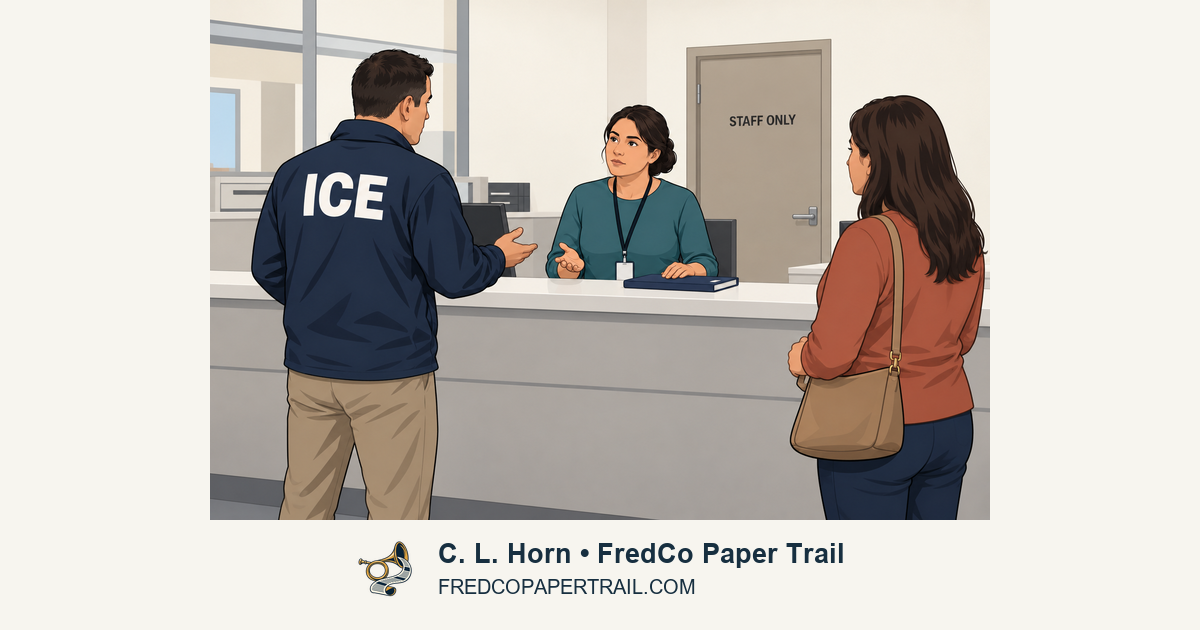
Frederick County Council voted 5–2 on October 20 to approve the Values Act, setting rules for how County employees respond when immigration officers seek help, information or entry to County facilities.
The debate made clear why supporters wanted those rules. M.C. Keegan-Ayer described residents afraid to leave home for work, shopping or medicine. Renee Knapp said the limits of County authority were no excuse to do nothing. The next question is how residents will learn whether employees follow the rules and when officers use the exceptions.
Who Voted For The Bill
The October 20 recording places the Values Act discussion at about 16:57. The roll call begins around 30:37, followed by the announced 5–2 result.
| Council Member | Vote |
|---|---|
| Mason Carter | No |
| Jerry Donald | Yes |
| Kavonté Duckett | Yes |
| M.C. Keegan-Ayer | Yes |
| Renee Knapp | Yes |
| Steve McKay | No |
| Brad Young | Yes |
This was the vote on the bill. The Council’s earlier unanimous vote, on October 6, adopted an amendment defining emergency circumstances.
The official bill index still showed no final disposition when checked October 22. The October 20 packet contains the October 6 amended draft, with enactment and effective-date fields blank. A signed final copy has not been located for this report.
What The Approved Proposal Would Require
The filed text limits voluntary access to nonpublic County areas and assistance with information for immigration enforcement. It restricts use of County property, questions about immigration status and contracts with ICE, while retaining legal and emergency exceptions.
It directs the County Executive to prepare instructions, sample scripts and warrant guidance. Divisions must train employees and mark nonpublic areas. It does not authorize employees to obstruct officers.
The text does not require an incident report, complaint process or regular public accounting. Those omissions leave residents without a bill-specific way to track encounters or challenge how employees handled them. Read the filed text.
The Debate Was About Protection, Authority And Consequences
McKay argued that the bill improperly directs executive-branch employees and questioned creating a law without a penalty for violating it. He referred to concerns he attributed to the County Attorney’s Office. Duckett challenged that account, and McKay acknowledged he did not have a written opinion to provide. The exchange did not establish a written County Attorney ruling that the bill violates the charter.
Carter argued that the measure could expose Frederick to federal funding consequences. That was his warning, not evidence that the vote had caused a grant loss.
Donald defended the bill as putting existing County policy into law. He also argued that penalties would be unfair to employees facing a difficult enforcement encounter.
Keegan-Ayer focused on residents’ fear and the need to guide employees. Knapp defended taking action within the County’s limited authority. Young said the measure would show residents that their County supports them. These arguments appear in the October 20 debate, approximately 18:00–30:35.
What Residents Should Be Able To See Next
The implementation questions are practical. Which office reviews a warrant? Who receives notice when an officer claims an emergency? Who records what the County allowed, refused or disclosed? Where can an employee or resident raise a concern?
The instructions should also identify which offices and facilities follow which rules. Donald again described the measure as not affecting the Sheriff’s Department or Board of Education. Residents need an official explanation of those boundaries, including what applies when different agencies work together.
Sensitive personal information should stay protected. A public summary can report the number of encounters, claimed exceptions and complaints without naming the people involved. The County can explain its actions without building a public list of residents’ immigration information.
The Council has cast its votes. The signed bill, effective date and instructions for carrying it out are the next records to put before the public.
Earlier coverage: Who Does Frederick’s Values Act Cover—and Who Keeps the Record?
Corrections: FredCo Paper Trail welcomes corrections supported by source records. Read the corrections policy.