Rowan Mailer Audit, Part 9: What Kind Of Jobs Is Rowan Counting?
Rowan promotes construction work, career pathways and operating jobs. Its employment figures use different units, timeframes and project scopes.


Rowan’s Frederick County mailer presents a large workforce, a construction-career pipeline and a worker’s account of better pay as part of its case for local benefit.
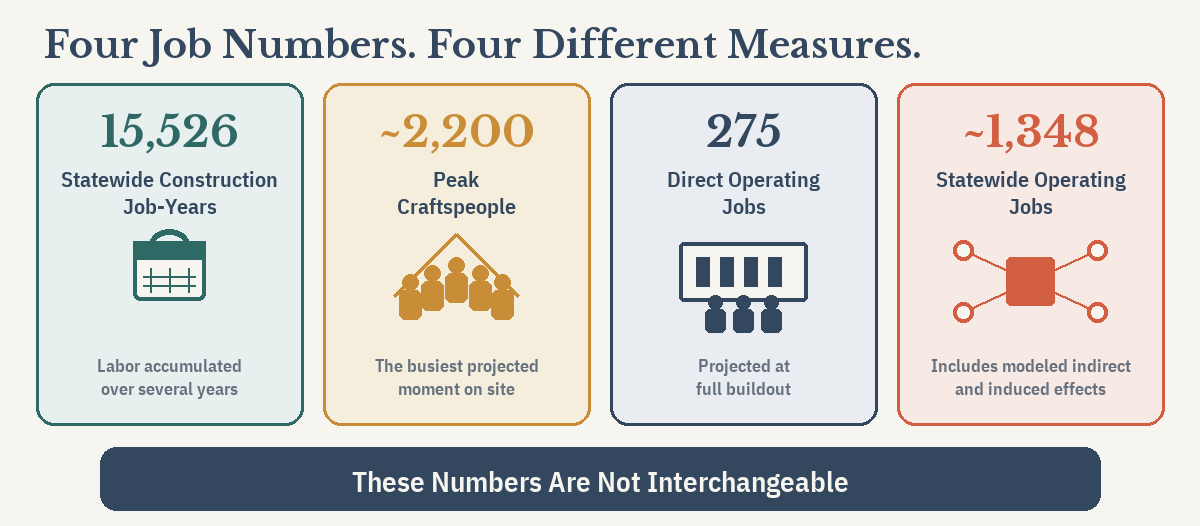
The jobs are not one category. Some figures describe labor accumulated during construction. Another describes the busiest projected day on site. A much smaller number describes the workforce expected after the buildings open.
Construction work can support a lasting career. It does not follow that a construction assignment lasts as long as the data center.
A Job-Year Is Labor Over Time
Sage Policy Group’s December 2024 economic analysis estimates 15,526 construction-period job-years across Maryland. It uses IMPLAN, an economic model that estimates direct work and additional employment supported through suppliers and household spending.
Of that total, 10,365 are direct construction job-years in Frederick County. The model adds 3,936 secondary job-years within the county and 1,227 elsewhere in Maryland. Sage cautions that its rounded totals may not add exactly.
A job-year is a unit of employment over time. Three jobs lasting four months each can add up to one job-year. It is neither a count of distinct people nor automatically a full-time-equivalent position.
Rowan’s current FAQ does explain the one-year definition. That disclosure matters. Readers should not have to carry it into every other use of a large jobs headline.
A Peak Forecast Is Not An Employment Count
Sage attributes the roughly 2,200-person peak construction workforce to conversations with Rowan. That is a projection of how many craftspeople would be on site at the busiest point across the three projects.
Rowan’s current projects page separately says Bauxite I, II and III have brought more than 2,000 jobs to Frederick County. The page supplies no counting method, reporting period or supporting workforce table.
The two figures are close. That does not prove they measure the same thing, that the later claim came from the peak forecast, or that the projected peak was reached.
A Lasting Career Is Different From A Lasting Assignment
The mailer’s construction-employment feature says, “These are not temporary jobs.” The Sage report expressly describes construction employment as temporary and separates it from ongoing operations.
There is a stronger, narrower case for the career claim. Baltimore Electrical JATC combines classroom instruction and on-the-job training with employment through participating electrical contractors. Skills, apprenticeship hours and credentials can remain useful after one building project ends.
A tradesperson may move from a Bauxite assignment to another construction site. That can be a continuing career. It does not make the original assignment a permanent position at Bauxite.
The Operating Projection Has Changed
The original Sage model estimates 275 direct operating jobs and 1,348 statewide operating jobs after secondary effects. Those are projections for steady operations, rather than current payroll results.
Rowan’s later materials use a newer direct-job claim:
- December 2024: Sage models 275 direct operating jobs for the three original developments.
- September 17, 2026: Rowan’s corporate article promotes more than 330 permanent full-time positions and attributes its economic claims to independent analysis.
- September 2026 Expansion Proposal: Rowan’s projects page says additional buildings at Bauxite II and III would support at least 60 full-time jobs if approved.
- October 21 Check: Rowan’s FAQ still presents nearly 275 full-time permanent positions for the initial projects.
Adding 60 to 275 produces 335, which fits the newer 330-plus claim. That is a plausible explanation, not a verified account of Rowan’s calculation. The September article does not identify or link an updated report establishing that calculation.
The original model describes annual, ongoing employment. Its job measure does not independently establish that every position is full-time and permanent. Those descriptions belong to Rowan unless staffing records support them.
Rowan also identifies itself as the developer, rather than the operator. A job at a Rowan-developed facility is not automatically a job on Rowan’s payroll. Nor does its location establish that a Frederick County resident holds it.
One Worker’s Story Is Not A Workforce Average
The mailer attributes a wage increase of nearly 60 percent to Dylan Bernales after entering a union apprenticeship. That is an individual account. The reviewed evidence does not independently verify his personal pay history or establish an average increase for the workforce.
The broader pay figures need their own labels. Sage’s nearly $70,000 construction figure and operating figure approaching $100,000 describe modeled annual compensation, including wages and benefits. Rowan’s FAQ calls the operating figure a salary. The linked report does not support that substitution.
A photograph of workers at a topping-out ceremony supplies no payroll, residency or retention count. Reaching that construction milestone also does not establish that a facility is operating.
What Would Establish The Employment Benefit
Construction contracts, apprenticeship placements and ongoing operations can provide real economic value. Temporary work is not worthless work, and a job does not have to be held by a county resident to generate local spending.
The missing evidence is more specific than whether any benefit exists. To establish the scale Rowan promotes, the company and the actual employers would need dated workforce summaries showing distinct workers, peak attendance, hours worked, employer and contractor categories, and aggregate county-of-residence information. Operating projections need a staffing plan and a stated project scope.
Those records can be summarized without publishing workers’ names, private pay records or home addresses.
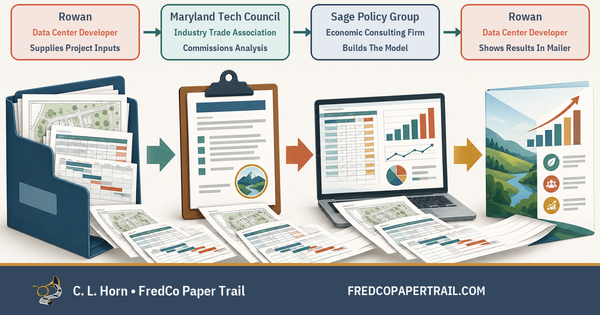
Next, the series examines who commissioned the economic analysis and what its description as “independent” establishes.
Corrections: FredCo Paper Trail welcomes corrections supported by source records. Read the corrections policy. Material changes will be dated and described on this article.