Rowan Mailer Audit, Part 11: Where Are The Local-Business Receipts?
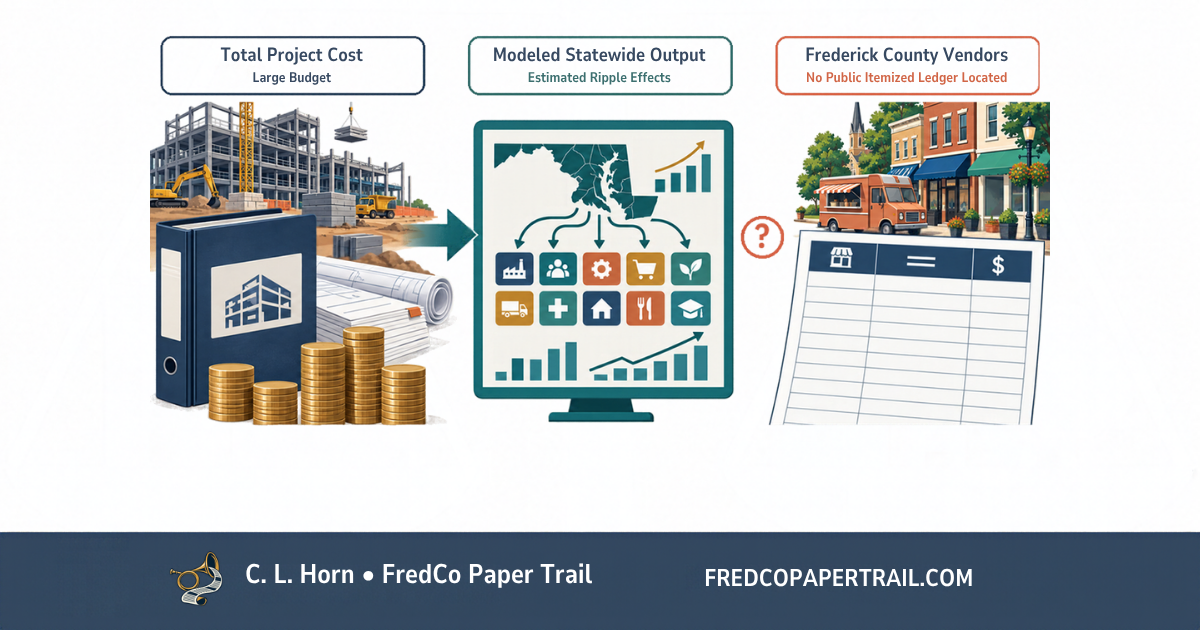
Rowan cites large construction and economic-output figures in a story about local small businesses. The reviewed sources do not supply a ledger quantifying Frederick County small-business payments.

“How Data Centers Fuel Local Small Businesses,” one mailer headline promises.
The pages beneath it offer several impressive figures: about $1.4 billion in construction investment, more than $2.2 billion in statewide economic activity, nearly 3,900 secondary Frederick County construction job-years and modeled effects across at least 109 industries.
Those figures describe scale. They do not answer the headline's most local question.
Which small businesses were paid, and how much?
Project Cost Is Not Local Procurement
The $1.4 billion figure is the modeled cost of constructing the powered core-and-shell facilities in the analyzed scenario. It is an estimated cost, not a statement of spending already completed. It covers the buildings' powered structures, excluding equipment inside them. The public report does not turn that total into a list of Frederick County vendors.
Money can follow many routes. An out-of-state contractor may work locally. A national supplier may deliver equipment to the site. A Frederick business may receive one subcontract while most of a contract leaves the county.
Project cost, local spending and small-business spending are different categories.

Rowan mailer, page 14. The headline presents a local-small-business story with construction and operating forecasts. Source material reproduced for reporting, commentary, criticism and fact-checking. Image-handling methodology.
Output Is Not A Stack Of Receipts
Sage modeled approximately $2.2268 billion in statewide construction output, expressed in 2023 dollars. The report's construction table separates direct and secondary effects. Economic output includes direct activity and the indirect and induced effects generated by the model.
It is not $2.2 billion in checks written to Frederick County small businesses.
The 109-sector figure belongs to a different part of the forecast: operations after full build-out. Sage projects at least one supported job in each sector. It does not identify 109 companies, much less 109 Frederick County firms. Construction totals and ongoing operating effects describe different periods.
“Whenever Possible” Is Not A Standard
The mailer says Rowan encourages contractors and project partners to identify qualified local suppliers whenever possible. That is a claim about encouraging other buyers, not a report of purchases already made.
It does not define “local,” identify the size standard for a small business, establish a target or report a result. Local could mean Frederick County, Maryland or a broader region. “Whenever possible” leaves the decision rule entirely with the buyer.
A measurable procurement program would define the terms, report spending by category and explain who made the purchase: Rowan, a general contractor, a subcontractor, a tenant or another entity.
Photographs Show Examples, Not Totals
The mailer includes food trucks and a community dinner. Those events may have supported real vendors and brought workers and residents together.
Without the vendor names, business locations, invoices and payer information, the photographs remain examples. They do not prove the total amount of local procurement, and event spending says little about the much larger flow of construction contracts or long-term operating purchases.
“For Decades” Is A Projection
The mailer says operating activity will continue for decades, suggesting a durable market for suppliers after construction ends.
The Sage model estimates annual activity at a steady state. The reviewed record does not guarantee a tenant term, a local purchasing share or a particular vendor distribution for decades. Construction and operations also require different workers, materials and services.
Rowan could reasonably argue that businesses benefit even when every subcontract is not public, and that a general-audience mailer cannot reproduce every invoice. A useful disclosure would not require that. Aggregated spending by vendor location, business size, year and category could protect sensitive terms while letting the public test the claim.
Next, the series turns from modeled economic effects to a recorded tax payment and asks what Rowan's $50 million claim actually measures.
Previous: Part 10: Who Produced Rowan’s “Independent” Economic Analysis?
Corrections: Read our corrections policy. Material corrections will be dated and explained. Read our methodology.