One Campus, Many Permits: Who Decides What Counts as One Data Center?
Quantum Frederick is one master-planned campus, but Maryland regulates its data centers through separate air permits. The missing public explanation is how the state decided which facilities count as unrelated pollution sources.

National reporting this weekend gave Frederick County residents a new reason to look closely at a familiar place: the Quantum Frederick data-center campus in Adamstown.
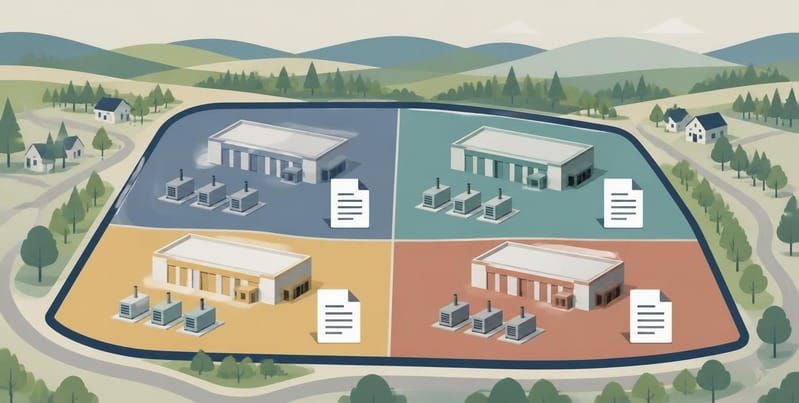
The Guardian reported Sunday that four data centers on the campus have separate minor-source air permits, including one held by Amazon. The article placed Frederick inside a broader national debate over what environmental advocates call “lego permitting”: dividing a large development among separate permits that receive less intensive review than one major pollution source.
Separate permits are not automatically improper. A campus can contain genuinely independent companies with different owners, operators and pollution sources. The legal question turns on more than what the development looks like from the road.
For Frederick County, the useful question is this:
Who decided that the facilities inside Quantum Frederick should be treated as unrelated sources, and what evidence supports that decision?
One Campus Does Not Automatically Mean One Source
Maryland's own records describe Quantum Frederick as a roughly 2,100-acre site managed by Catellus, formerly Quantum Loophole, containing smaller parcels where separate companies are developing data centers.
A December 2025 letter submitted on behalf of Quantum Maryland described the property as a 2,122-acre master-planned campus. It said three sites had been transferred to Rowan Digital Infrastructure and one to Aligned Data Centers, with facilities under construction on all four.
The Maryland Department of the Environment separately identifies an Amazon Data Services project with four buildings, an Aligned Data Centers parcel, and three Rowan parcels known as Bauxite I, II and III.
Those distinctions matter because federal and Maryland air-permitting rules do not define a source by drawing one line around every neighboring building.
Maryland says a group of stationary sources is treated as one major source when the facilities are on contiguous or adjacent properties, belong to the same major industrial grouping, and are under common control.
All three parts matter.
The campus is physically connected. The data-center uses appear closely related. But separate parcels, leases, tenants, generator owners and operating agreements may produce different answers to the common-control question.
That is the strongest case for separate permits: the legal and operational distinctions may be real.
Maryland Has Already Used The Word “Unrelated”
The public record also contains a revealing exchange.
During review of Aligned Data Centers' Frederick permit, a commenter asked when Maryland would begin looking at aggregate emissions across the Adamstown site.
MDE responded that emissions from “unrelated air pollution sources in the same area” are not combined when the department evaluates a Clean Air Act permit application. It said future sources would be evaluated when those applications arrived.
That answer tells the public the rule MDE applied. It does not show the underlying source determination.
The permit records reviewed for this article do not yet provide a campus-level explanation of why the Amazon, Aligned, Rowan or other reported facilities qualify as unrelated. They do not show which ownership, lease, management or operational relationships MDE examined; who controls the generators; or whether those relationships could change over time.
That missing explanation matters because “unrelated” is not a geographic description. It is a regulatory conclusion.
The Individual Permits Still Reveal Different Assumptions
Frederick residents have already asked MDE to compare permits within the campus.
In the Amazon Bauxite permitting record, a commenter contrasted Amazon's proposed annual diesel-fuel allowance with the lower allowance in Aligned's Frederick permit. MDE reviewed each facility under its own application and permit conditions.
Aligned's final determination treats its facility as a minor source and sets a premises-wide limit of less than 25 tons of nitrogen-oxide emissions during any rolling 12-month period. When asked whether the department looked at generators individually or together, MDE said its review considered individual engines, groups of units and the premises as a whole.
That is aggregation within one permitted premises.
It is not the same as a public accounting of cumulative generator capacity and emissions across the larger Quantum Frederick campus.
The regulatory map and the physical map are answering different questions.
What Maryland Should Put In One Place
The next step is not to declare that Frederick County has uncovered an illegal permitting scheme.
The next step is to make the state's reasoning visible.
For every data-center facility within Quantum Frederick, the public should be able to identify:
- the parcel and property owner;
- the developer and building owner;
- the tenant or data-center operator;
- the owner and operator of the generators;
- the applicable air permit;
- the permitted generator count and operating assumptions;
- the facility's potential emissions;
- the entity with operational control; and
- MDE's basis for treating that facility separately from the others on the campus.
That record would let residents distinguish lawful separation from regulatory fragmentation without guessing about either one.
It would also answer a broader accountability question: where can the public see the cumulative picture even when the law properly regulates facilities one at a time?
The Unit Of Regulation Shapes What The Public Can See
One physical development can contain several legal owners. One master plan can contain several operating companies. One campus can produce several permits.
Those distinctions may be accurate and legally necessary.
They can also make the whole system difficult to see.
📯 Horn's inference: Oversight works best when the unit being regulated matches the scale at which consequences accumulate—or when government supplies a second, public view that reconnects the pieces.
For Quantum Frederick, the immediate question is not whether four permits exist.
It is who decided that four permits describe four unrelated sources, what evidence supported that decision, and where Frederick County residents can see the campus as one environmental system.
Source Links
- The Guardian, September 27, 2026: https://www.theguardian.com/us-news/2026/sep/27/datacenter-developers-us-pollution-rules
- Maryland Department of the Environment, Frederick Data Center Sampling/Reports: https://mde.maryland.gov/datacenters/Pages/FrederickDataCenter.aspx
- MDE, Aligned Data Centers final determination and response to comments: https://mde.maryland.gov/programs/land/MarylandBrownfieldVCP/Documents/FinalDetermination-Aligned.pdf
- MDE, Amazon Data Services final determination and response to comments: https://mde.maryland.gov/datacenters/Documents/2026_FinalDeterminationandResponsetoComments.pdf
- MDE, Title V Fact Sheet: https://mde.maryland.gov/programs/permits/airmanagementpermits/pages/title5factsheet.aspx
- U.S. EPA, Clean Air Act Resources for Data Centers: https://www.epa.gov/stationary-sources-air-pollution/clean-air-act-resources-data-centers
- Frederick County, December 2025 Quantum Maryland submission: https://frederickcountymd.gov/DocumentCenter/View/358567