Rowan Mailer Audit, Part 12: What Rowan's $50 Million Tax Claim Actually Measures
Rowan’s tax headline holds up. Its company-branded presentation turns public revenue into a goodwill story the receipt alone cannot establish.

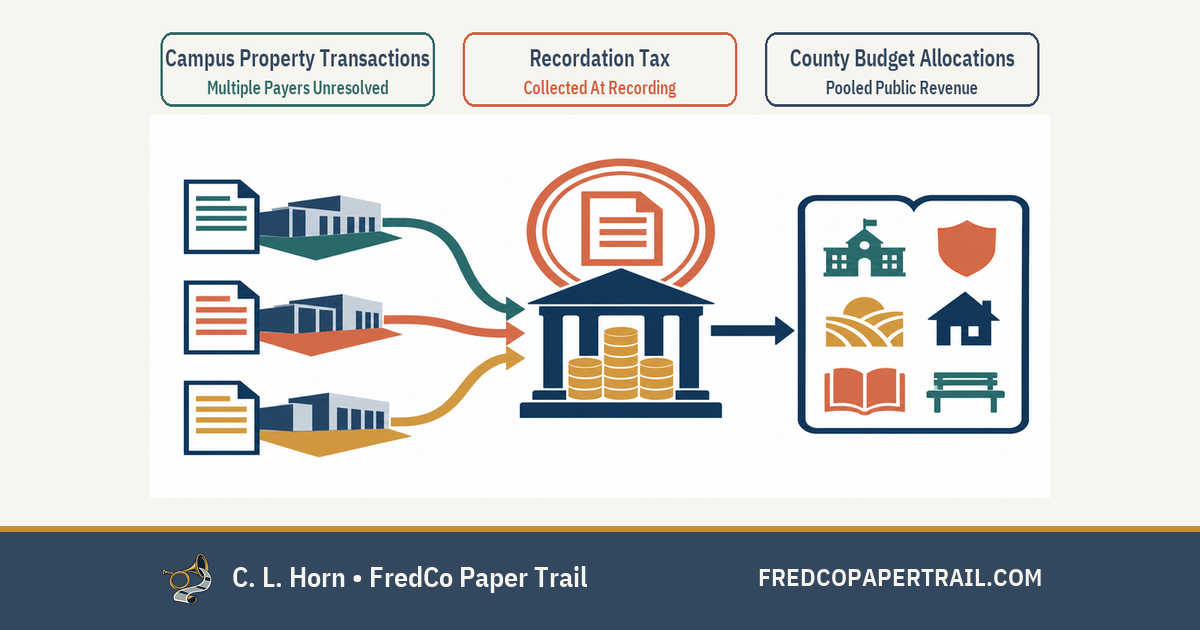
Rowan’s mailer says Frederick County has collected more than $50 million in recordation taxes from data-center-related real-estate transactions since 2021. Frederick County’s own published account supports that headline amount.
The surrounding text deserves fair treatment. The mailer explains the transaction tax, distinguishes money already collected from later operating revenue and describes county rules for distributing it. It does not expressly say Rowan alone paid the entire sum or that the same amount arrives every year.
But the presentation makes a broader argument. Beneath Rowan’s branding, the tax receipt sits beside a photograph of its team and an account of benefits to schools, farmland and local services. Rowan uses public revenue to build its corporate goodwill story.
The amount can be accurate while that broader argument still needs examination.
What The Mailer Gets Right
Page 4 is headed “How Data Centers Are Funding Frederick County.” It describes taxes already collected and distinguishes those receipts from projected jobs and future economic effects. Page 5 repeats the amount and identifies the collection period as beginning in 2021.

Rowan’s mailer, page 5. The accompanying page 4 article explains the transaction tax and county allocation rules. The county separately reports $50.6 million through June 30, 2026. Cropped by FredCo Paper Trail for reporting, commentary, criticism and fact-checking. The photograph does not identify individual tax payments.
The text explains that property transactions produce recordation revenue before long-term operating taxes come into play. It discusses land transactions and secured debt, gives the county’s rate and describes public allocation rules.
Frederick County’s deed-recording guidance confirms a rate of $7 per $500 of consideration, rounded up to the next $500 increment. Consideration is the value exchanged in the transaction. A taxable $1 million deed would therefore generate $14,000 before an exemption or adjustment.
The county’s data-center FAQ reports approximately $50.6 million in recordation taxes through June 30, 2026, attributed to Quantum Frederick developers collectively. That supports the mailer’s rounded headline.
How A Tax Receipt Becomes Corporate Goodwill
Rowan places the tax story inside a company-branded mailer about its Frederick County impact. The public-service headline names schools, farmland and local services. The facing page places the large tax figure above a photograph that the mailer identifies as Rowan officials meeting at a Frederick County site.
That arrangement connects the company, the receipt and familiar public benefits. It makes taxation part of Rowan’s account of being a valuable community presence.
The distinction is between the revenue and the credit being sought for it. Recordation tax follows the rules governing taxable transactions. It is not a voluntary donation. County policy determines the allocation; Rowan does not choose those public purposes simply by participating in transactions that generate the tax.
There is also an attribution limit. Quantum Frederick is the larger campus that includes Rowan’s Bauxite projects. The county’s published total does not separate receipts by company or recorded document. It therefore does not establish Rowan’s individual share.
The mailer’s tax passage describes county revenue from data-center-related transactions rather than expressly assigning the entire sum to Rowan. Its corporate framing is observable. A false company-only payment claim is not established by that framing alone.
Public Allocation Needs Dates And Records
The mailer describes 47.86% of recordation-tax revenue going to the General Fund, which supports general county services. It describes the remaining 52.14% as dedicated to purposes including farmland preservation, recreation and open space, school construction and housing. It presents a possible transit allocation as a policy discussion.
That General Fund share matches the FY2026 baseline in Finance Director Erin White’s fiscal note for Bill 26-03. The note places the fiscal effect of a 2% transit dedication in FY2027 and beyond, reducing the unrestricted General Fund share to 45.86%. It describes a reallocation, not a net revenue increase.
FY2027 began July 1, 2026, after the cutoff for the reported campus total. The current county FAQ lists the transit share beside that earlier total without separating the periods. The mailer’s discussion of a possible allocation and the county’s current summary should not be treated as the same dated statement.
Neither a list of funding categories nor the aggregate tax receipt traces a particular developer’s payment to a particular school, farm or service. That requires the applicable allocation rules and accounting records.
What The Receipt Cannot Settle
Rowan’s strongest fair argument is straightforward: these transactions produced substantial public revenue, and residents evaluating development should know that. The mailer explains the tax mechanism rather than merely displaying an unexplained number.
That is useful information.
It is not a calculation of the development’s overall public value. The receipt alone does not compare revenue with infrastructure costs, public-service demands or environmental and quality-of-life effects. Some effects require financial accounting; others require separate evidence and public judgment.
The same boundary applies in the other direction. An incomplete accounting does not establish that the development’s costs exceed its benefits. Nor does the absence of transaction details from the reviewed summary establish that the county lacks those records.
A transaction list identifying dates, documents, payers and taxes collected, together with actual fund allocations by year, would resolve the remaining accounting questions. Evaluating the overall bargain requires the cost side as well.
Previous: Part 11, Where Are The Local-Business Receipts?
Sources
- Rowan mailer, pages 4–5; page 5 crop reproduced above.
- Frederick County Data Center FAQ
- Frederick County: Record A Deed
- Fiscal Note For Bill 26-03
- Bill 26-03: Adopted Text