What the City of Frederick’s Proposed Data Center Moratorium Would Actually Pause
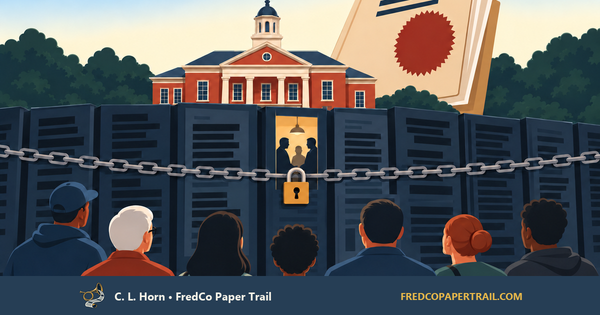
The draft would freeze land-use amendments for data centers in the City of Frederick while officials study their impacts. It would not create a permanent ban, prohibit all developer contact, or produce a vote at Thursday’s work session.


By C. L. Horn
The City Council for the City of Frederick will discuss a proposed two-year data-center moratorium Thursday at 6 p.m. It will not vote on the measure at that work session.
That distinction matters. The draft is neither a permanent ban nor a pause on every kind of City activity involving data centers. It would freeze one specific legal pathway: applications to change the City’s Land Management Code so data centers can become an allowed land use.
The proposal would preserve the current rule while the City studies what should come next. The real accountability question is whether the City has defined how it will use that time.
The City of Frederick Already Does Not Permit Data Centers
The record. The proposed ordinance says the City of Frederick’s Land Management Code does not list data centers, or a materially similar use, as an allowed land use. In the draft’s words, that makes such facilities “effectively prohibited.” If adopted, the moratorium would prevent the City from accepting, processing, or approving an application to amend the code to allow what the ordinance calls critical digital infrastructure facilities. It would apply to applications submitted before and after the ordinance takes effect.
The companion executive summary says several developers have proposed creating a new land-use category and that one proposal is already under Planning Commission review.
In plain language. A developer cannot currently move directly from a data-center proposal to a building permit in the City of Frederick. The land-use code would have to change first. The moratorium would pause applications asking the City to make that change.
📯 Horn’s take. This is not merely a statement about a hypothetical future project. The executive summary says an active proposal is already under review. Freezing the code-change route would therefore interrupt a process that has begun, even though it would not permanently decide whether the City should allow data centers.
The Permit Restriction Is Not Limited To Two Years
The record. The draft says no building permit, certificate of occupancy, or other approval may be issued for a data center unless the Land Management Code first allows the use. According to the ordinance, that restriction comes from existing zoning requirements. It is not created by the proposed moratorium and would not automatically disappear when the moratorium ends.
In plain language. The proposed two-year clock applies to applications seeking to change the land-use code. The underlying barrier to permits remains unless the Council changes the code.
📯 Horn’s take. Calling the proposal a “two-year ban” blurs two separate things: a temporary pause on code-change applications and the existing rule that already blocks data-center permits. Residents should evaluate the moratorium for what it changes, not give it credit for a restriction already in place.
The Study List Is Broad
The record. The proposed study would examine noise, vibration, water use and quality, air pollution from backup generators, electricity demand and ratepayer effects, power delivery and self-generation, greenhouse-gas emissions, light pollution, wildlife, and community character.
It also calls for an economic comparison based on tax revenue, assessed property value, employment density, and overall economic benefits relative to other intensive industrial and commercial uses. The study would examine setbacks, zoning near homes and schools, design and operating standards, and possible changes to the City Code.
In plain language. The City is not proposing to study only whether a data center can fit on a parcel. The draft asks officials to compare what the use would demand from public infrastructure and nearby communities with what the same land and capacity could produce under other uses.
📯 Horn’s take. That comparison is necessary. A data center should not be judged only against an empty parcel or a developer’s headline revenue estimate. The useful comparison is between realistic alternatives, with costs, risks, jobs, revenue, and infrastructure demands measured on the same terms.
The Work Plan Is Still Missing
The record. The ordinance requests that the Mayor’s office, other City staff, or retained consultants conduct the work in coordination with the Planning Commission. It does not name a lead office, establish a citizen-led committee, set a budget, identify interim deadlines, require publication of underlying data, or define how competing claims will be evaluated.
The executive summary leaves its fiscal-impact, Neighborhood Advisory Council impact, equity-impact, and staff-or-commission recommendation sections blank.
In plain language. The draft contains a long research agenda but not a management plan. It says what should be studied without assigning each job, setting public milestones, or defining what would count as a completed study.
📯 Horn’s inference. Creating time is not the same as creating an accountable process. Without ownership, deadlines, disclosure rules, and a completion standard, the City could reach the end of the pause with plenty of activity but no common measure of whether the work is finished.
A Moratorium Is Not A No-Contact Rule
The record. The Frederick News-Post reported that Citizens for Responsible Growth member Steve Jakubczyk argued a moratorium should prevent further contact between the development community, the technology industry, and City employees. That is an advocacy position, not a provision in the draft ordinance.
The text would stop specified land-use applications and approvals. It would not prohibit meetings, lobbying, informal conversations, or technical consultation. It also asks City staff and possible consultants to study regulatory approaches, work that could involve gathering information from many interests.
In plain language. Adopting this ordinance would not create a communications blackout. City officials and employees could still hear from developers, residents, utilities, experts, and advocacy groups unless the Council adopts separate disclosure or contact rules.
📯 Horn’s take. Residents may reasonably want meeting logs, conflict standards, or other transparency requirements. If the Council wants those safeguards, it should write them into an enforceable rule. Calling the current draft a no-contact policy would promise a protection it does not contain.
Two Years Is A Maximum, Not A Guaranteed Study Period
The record. The proposal would expire at the earliest of three events: enactment of zoning amendments addressing data-center impacts, expiration of the two-year term, or Council repeal. The Council would also retain the power to modify or extend the moratorium.
In plain language. The City could reopen the code-change pathway before two years have passed. Two years is the outer limit in the current draft, not a guaranteed minimum study period.
📯 Horn’s take. Supporters may see that flexibility as practical, while critics may worry that a future code amendment could end the pause before the public believes the study is complete. The answer is to define completion before the clock starts—not to pretend the draft creates a fixed two-year wall.
The County’s Pause Is Separate
The record. Frederick County says it is not accepting new applications for new data-center developments and has extended its pause to July 1, 2027. The County also says the pause excludes certain properties with earlier development approvals and does not stop projects already under construction.
That County policy does not govern land inside the City of Frederick. The City proposal concerns whether the City will accept applications to change its own Land Management Code.
In plain language. The City of Frederick and Frederick County are separate land-use authorities. A pause adopted by one does not automatically apply inside the other, and the two measures do not stop the same stages of development.
📯 Horn’s take. Treating the City and County policies as one moratorium obscures who has authority and what each measure controls. Residents need the jurisdictional line because accountability follows the government that can actually make the decision.
Thursday Is The Beginning Of The Legislative Process
The record. The City identifies the October 8 meeting as a work session. Its meeting procedures say work sessions are discussion-focused and no formal votes are taken. The executive summary says Council Member Derek Shackelford will consider the feedback and work to advance the proposal through the legislative process. The draft still has blank spaces for an ordinance number, introduction date, action, passage, and approval.
The City anticipates high attendance and says the meeting will begin at 6 p.m. in the Board Room at City Hall, with overflow space if needed and a live broadcast available.
In plain language. Thursday is a chance to shape the proposal, not the meeting at which it becomes law. Any ordinance would still need to advance through the City’s formal legislative process.
📯 Horn’s take. The choice before residents is not yet “moratorium or data center.” It is whether this draft creates a credible public process for deciding what evidence, protections, and tradeoffs must come before the City changes its law. A pause can prevent a rushed decision. It can also become an empty interval. City residents should judge this proposal not only by the length of the clock, but by the work the City promises to finish before it starts moving again.
Source Links
- City Council agenda, October 8, 2026.
- Proposed data-center moratorium ordinance.
- City executive summary.
- City Council meeting procedures.
- City high-attendance notice.
- Frederick County data-centers page.
- Frederick News-Post report by Katelynn Winebrenner, supplied to FredCo Paper Trail.